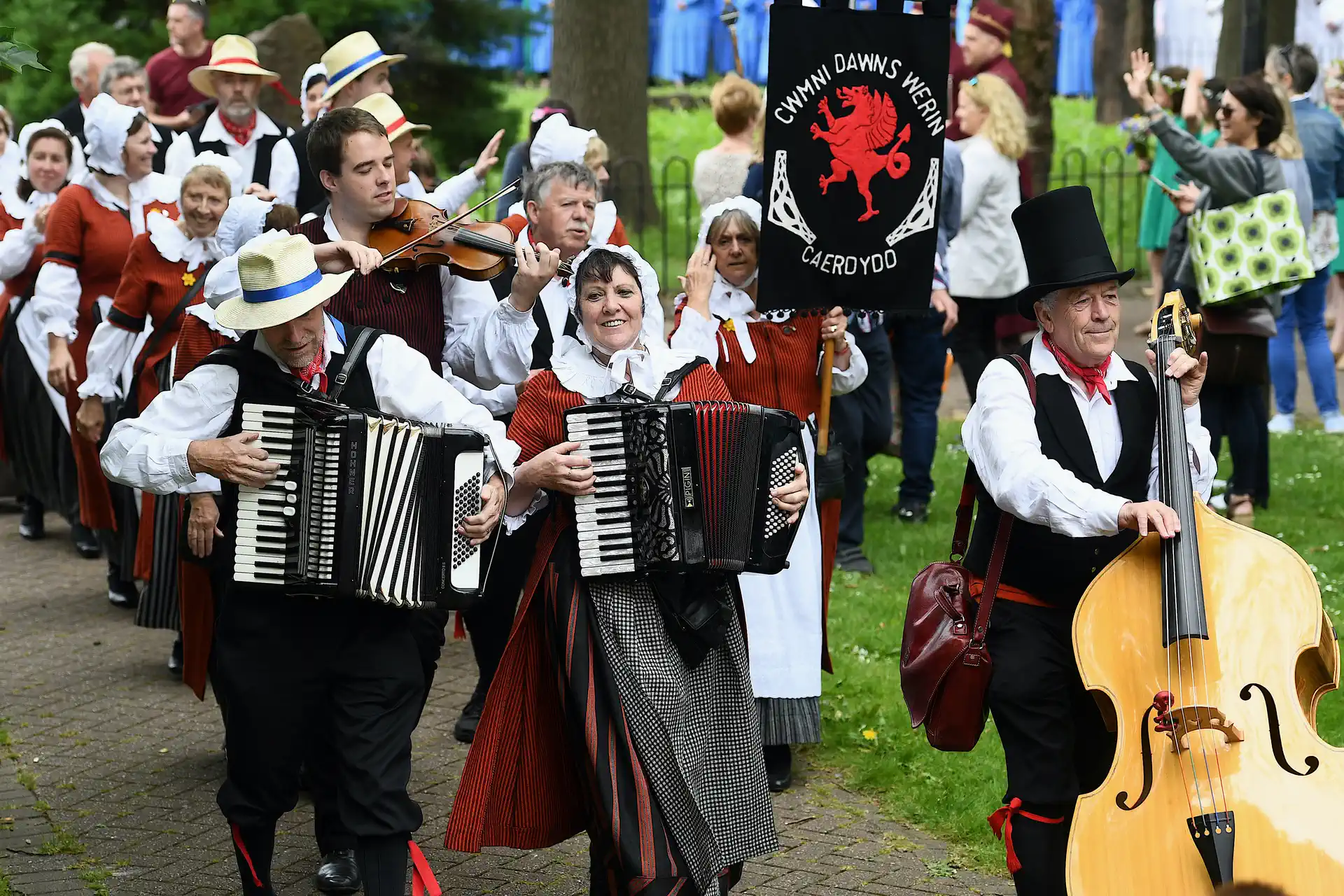
Symbols of Wales are plentiful. Let’s look at a few handpicked favourites which have come to be essential ingredients when advertising anything ‘Welsh’, such as national events and traditional produce. Take, for example, Wales’s National Eisteddfod. Still held annually at the beginning of August, this festival; historically centered around literature, music, art and poetry, made a profound use of Welsh symbols in its promotions. See Wales for yourself to experience its legendary symbols up close, and for a genuine taste of Welsh life, consider one of the many historic stays UK offers.
Symbolism, pageantry and ceremony played an important role in a Welshman’s life during the 19th and 20th centuries. These customs fed into an effort to project Welsh identity, at a time when indigenous cultures were consciously displaying their distinctiveness. The National Eisteddfod’s official programmes show how meaningful symbols were used to project ‘Welshness’. So, here is a brief history of the National Eisteddfod.
Starting in 1176, Lord Rhys hosted the first known ‘eisteddfod’. He held two major competitions at Cardigan Castle; one in poetry, and the other in music.
Similar tournaments were held in the 15th and 16th centuries. The phrase ‘eisteddfod’ was coined during this period. Sadly, these gatherings declined during the reign of Henry VIII.
Societies of London based Welshmen revived the eisteddfodic tradition at the end of the 18th century. Iolo Morganwg, inventor of the famous Gorsedd of the Bards ceremonies, played an important role in reviving the eisteddfod on a national scale by associating the Gorsedd with the institution.
Subsequently at Denbigh in 1860, a Council and General Committee were elected to manage ‘Yr Eisteddfod’, a newborn national organization. The following year, at Aberdare, the first official ‘National Eisteddfod’ was held.
Symbols and their roots…
Symbolizing Wales’s ancient roots, the Red Dragon (Y Ddraig Goch) is one of Wales’s most recognizable symbols. Believed to have been used by King Arthur and other Celtic leaders, it represents its formidable past warriors.
Similarly, the Triple harp (Y Delyn Deires) is thought of as Wales’s national instrument. Used for centuries to accompany folk-singing, dancing and poetry recitations, the triple harp epitomizes Wales’s rich literary and musical heritage.
Styled largely during the 19th century by a devoted cultural patron called Augusta Hall, or Lady Llanover, was the Welsh Dress (Y Wisg Gymreig). The most basic traditional Welsh costume consisted of a red woolen cloak and a tall black hat. She believed that such a custom would promote Welsh industries and identity.
Specifically devised by Iolo Morganwg, the Mystic Mark (Y Nod Cyfrin), the symbol /|, represents the virtues Love, Justice and Truth. The symbol was widely used on Eisteddfod programmes and represented the Gorsedd’s presence at the event. The Gorsedd was once thought of as an ancient Druidic circle which glorified Wales’s rich bardic tradition.
Symbols used on Eisteddfod programmes and posters can be considered within a wider context of a general effort to revive Welsh culture. It is clear that such a movement looked to the past for inspiration and encouraged Welsh people to take pride in their heritage and history.
Signature female Welsh costume (gwisg Gymreig), including the shawl (siôl), kerchief or fishu, cape or cloak (y clogyn), flannel petticoat (pais), tailored gown and bedgown (betgwn) fastened with thorn pins (pin draen), apron (ffedog), stockings (hosanau or sanau) and a tall black ‘stovepipe’ or ‘chimney’ hat (het Gymreig), with clogs (clocsiau), is a widely recognized traditional female Welsh costume (gwisg Gymreig), found on everything from maps, books and postcards to boxes of fudge. It is a romantic image and one that hints at a long history, however the reality is very different. This iconic costume was in fact created in the nineteenth century by a Monmouthshire woman of English descent: Augusta Hall known as Lady Llanover (1802-1896). One of Augusta Hall’s major passions was to preserve and popularise a sense of Welsh identity and she spent most of her life supporting the language, literature and national institutions of Wales. She turned her home, Llanofer House, into a centre of Welsh language and culture. Here she encouraged music, dance and Welsh literature, building up an extensive library (some of the contents of which are now held by the National Library of Wales). Augusta also financed the first periodical for women in Wales (Y Gymraes, in 1850) and became patron of the Abergavenny Cymreigyddion Society, a literary organisation that played a major role in the nineteenth-century revival of Welsh and Celtic scholarship. After winning a prize for an essay on Welsh language and traditional dress at the 1834 Eisteddfod in Cardiff, Augusta began calling herself Gwenynen Gwent (‘the bee of Gwent’). This linked her identity, in name and purpose, firmly to the cause of Wales. There was little distinctly Welsh about the clothes that Augusta based her version of Welsh national dress on, and much the same was worn by country women in England around this time too. Although black beaver hats had been worn by Welsh women from the end of the eighteenth century, the tall ‘chimney hats’ of the archetypal Welsh lady were a Victorian invention. Augusta was so excited by her idea of Welsh national dress that she required all her maids to wear it at work. She even built a woollen mill in the grounds of Llanofer House to produce the native cloth out of which the costume was made, giving a much-needed boost to local Welsh industry. At Llanofer, Augusta’s sometimes eccentric household and estate was populated almost entirely by Welsh speakers. In this way she is often credited as ensuring the survival of the Welsh language in this Anglicised area for another half-century or more. Augusta Hall was a strong-minded, imaginative women who played a huge role in the revival of Welsh culture in the nineteenth century. On her death in January 1896 she was remembered with affection for her long support of Welsh literary and national traditions. Today the Welsh tourist board have just as much reason to give thanks to Augusta, especially when they sell yet another doll in Welsh costume or any other tourist gift packaged with a woman in ‘traditional’ Welsh dress.
Snowdonia, with its dramatic peaks, mystical lakes, and ancient landscapes, is a breathtaking gateway into the heart and soul of Welsh culture. Steeped in legend and layered with centuries of history, it’s the perfect place to explore the rich tapestry of Welsh symbols, from the red dragon of mythology to the enduring legacy of language, music, and national pride. So for a truly immersive experience, find a chapel rental UK with deep Welsh roots, a property that echoes the stories of the land and offers an authentic sense of place like Salem The Blue Chapel. Whether nestled in a quiet village or perched on a hillside overlooking Snowdonia National Park, this is more than just a stay, it is a connection to Wales’ enduring heritage.
Snowdonia is the dream escape for UK holidaymakers, offering a rich blend of history, culture, and stunning natural landscapes waiting to be explored with mountain views, coastal charm, and unforgettable adventures in the heart of Wales. Serving the perfect blend of nature, relaxation, and adventure, it is ideal for romantic baecations, family holidays, friendcations, seaside retreats, solo travel, and wagcation/dog-friendly getaways. Such a scenic destination promises unforgettable views, rich Welsh culture, and easy access to Snowdonia National Park, where some of the most quirky places to stay in UK can be found. Seaside serenity and storybook-worthy charm await, so book your Snowdonia holiday rental in a peaceful Welsh coastal village for a truly memorable escape and really Slip Into Holiday Mode.
Sources for this article include: Llyfrgell Genedlaethol Cymru/National Library of Wales, Herstoria, John Cambrian Rowland, Amgueddfa Genedlaethol Caerdydd/National Museum Wales, The Costume Society, Welsh Hat, Mr and Mrs Hall, ‘The Book of South Wales, the Wye, and the Coast’ (1861), People’s Collection Wales.